02 — Orchestration
Company Cortex.
Run the discipline on top.
What it is
An AI middle-management layer that runs the operation.
The Cortex asks the standup questions and captures the answers. Follows up when the criteria aren't met. Briefs leadership on schedule. Tracks commitments across the week and surfaces the stuck ones. Watches the seams between teams and flags handoff failures before they become fires. Reads the company's operational data and answers questions about it in conversation.
It does the work humans wouldn't sustain — every day, without forgetting. Manage-by-exception, mechanized — at every level of the org, not just the top.
How it's shaped
A tree of modules, each owning a slice of the operation.
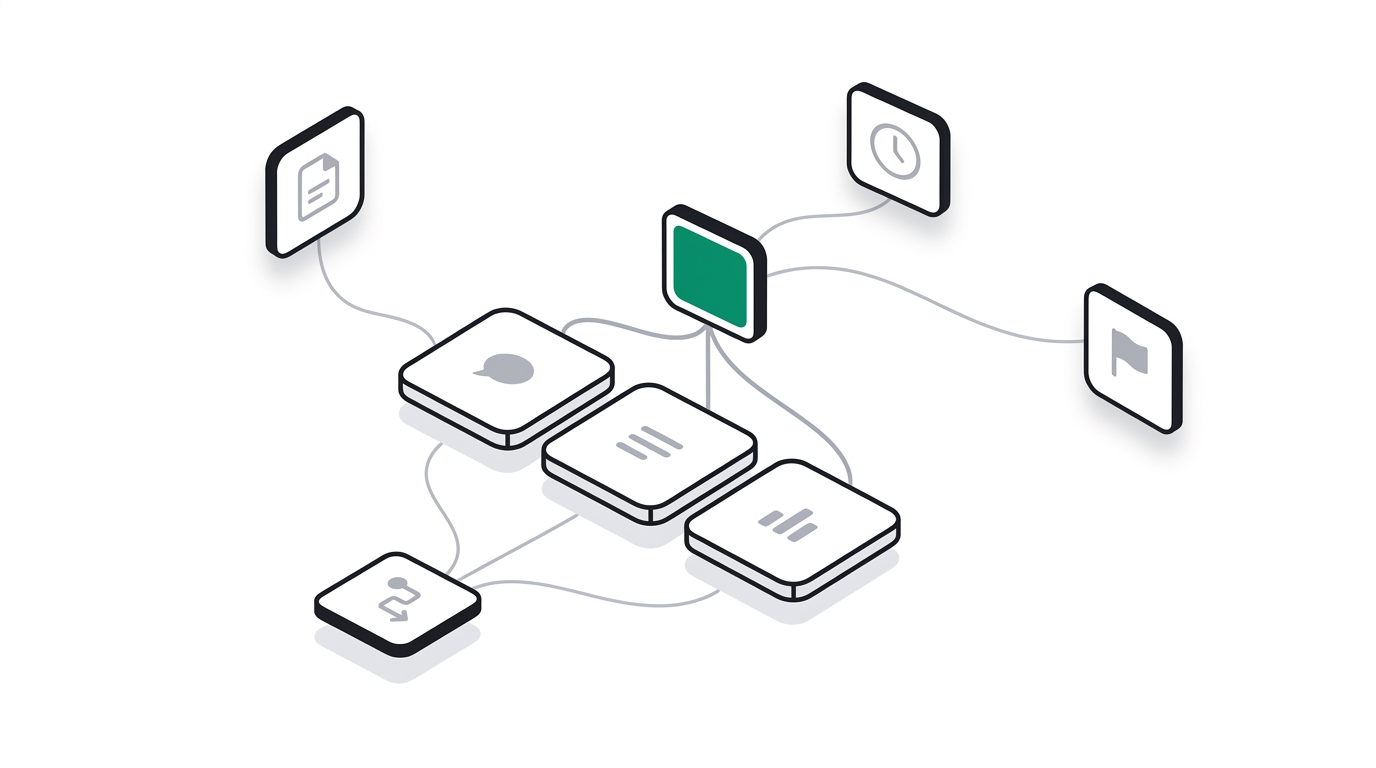
The Cortex is not one giant model that knows everything about the company. It is a tree of modules — each a self-improving loop over its own slice of the operation, each managed by the level above through outcomes rather than step-by-step instruction.
A standup module. A document-processing module. A voice-and-phone module. A metrics module. An account-management module. Each module has an objective, an outcome it owns, a playbook it runs, and a memory of what it has done. The architecture grows outward — one module at a time, each earning its place — until the operation is covered.
The discipline that decides what gets built is brief: no module without an objective; no objective without an outcome. That gate is what separates the Cortex from the agent-installation industry. Automating tasks because they happen to be painful produces a sea of useless bots. Running every unit against a stated outcome produces an operating layer.
What you get
Discipline that runs whether humans open it or not.
Every engagement starts with a single module — a named objective, a named outcome, a playbook the Cortex runs every day. A daily standup that the team responds to in Teams or Slack, with a leader brief on the CEO's desk by 7am. A document processor that reads new files and structures them into the operation's queryable record. A metrics module that asks owners for the week's numbers and trends them without a spreadsheet ever opening.
The promise is not that AI replaces the team. The promise is that the discipline the team was supposed to maintain — and quietly stopped maintaining at month six — runs anyway. The Cortex carries the part of the operating system that humans will not sustain.
The on-ramp
Conversation is the data.
The Cortex does not wait for Company Memory to be fully built. It builds Memory conversationally, from week one, while delivering value. Standup check-ins produce daily progress data. End-of-day reports produce time-attribution data. Topic-tagged conversations produce project-level operational ground-truth. The data the company did not have begins accumulating from the first conversation.
That is what makes the Cortex sellable as a first engagement, not a last one. A company can buy Cortex without yet having Memory — and find, eighteen months later, that it has both.
Where it fits
The second of three.
Company Memory is the data layer the Cortex acts on. Cortex Guard is the trust layer in front of every conversation the Cortex runs — identity, permission, audit. The Cortex sells on its own; in any deployment where the conversation reaches sensitive data, Guard sells with it.
Curious which module would be your first?
Thirty minutes. We listen to what the operation looks like, and tell you which module would change it most — and what it would take to install.