Management Cortex
The Daily Check-In, Run by the Cortex. Every Day. Without Forgetting.
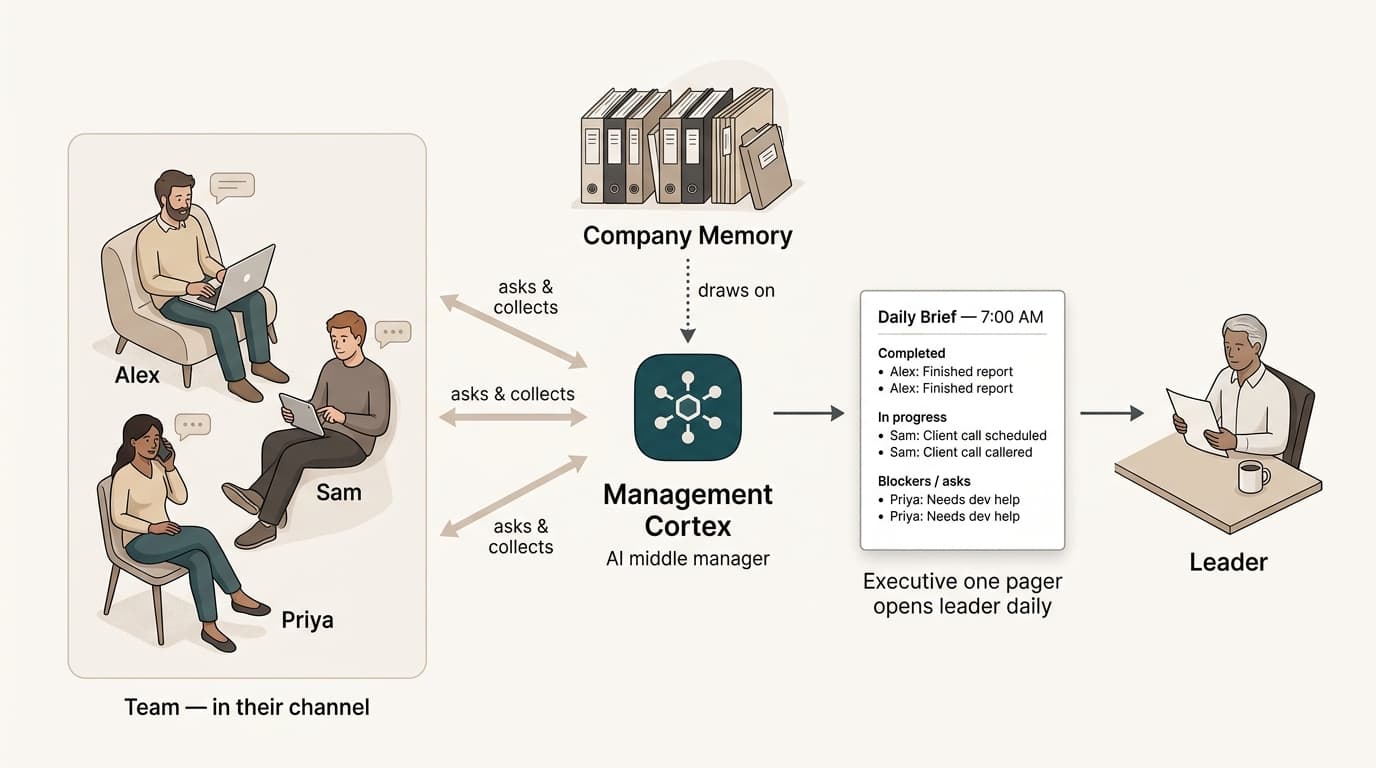
Each morning the Cortex asks each team member what they completed, what they're on for, what's blocked. One executive brief lands at 7 AM.
What it solves
Every operating system you have tried — EOS, Traction, Scaling Up — promised that the cadence would change the company. Most companies tried. Most quietly stopped.
The standup is the first thing to slip. Owners forget. Data goes stale. By month three it is theater. By month six it is gone.
Not because the framework was wrong. Because sustaining it — capturing the answers, following up on commitments, surfacing patterns across the week — is real work no team has bandwidth for on top of the actual operation.
How It Works
Each morning, the Cortex initiates a private check-in with each team member in the channel they already use — Teams, Slack, email, SMS.
It asks: what did you complete yesterday, what are you on today, what is blocked. It remembers prior commitments and follows up on open ones.
If an answer is ambiguous — "same as yesterday" — the Cortex asks a targeted clarifying question. It does not badger; it caps follow-up cycles.
Answers are captured in structured form and persisted to your tenant's database — your data, your IP.
By the time you want it, the Cortex composes a one-page executive brief: what completed, what is stuck, what changed, what is drifting from quarterly priorities.
Patterns surface across the week — a recurring blocker, a metric trending the wrong way, a commitment everyone has forgotten.
The standup is conversational, not a form. The discipline is captured by the cadence. Your team does not open an app, fill a spreadsheet, or attend a meeting they did not want to attend.

The conversation runs in Microsoft Teams, Slack, or email — the channel your team already uses.
What You Get
- Cortex deployed in your team's channel (Microsoft Teams, Slack, or email)
- Per-tenant database — your data, your operational IP, on infrastructure you control
- Custom standup questions aligned with your operation
- Daily executive brief delivered to leadership at the time you choose
- Pattern surfacing across the week — recurring blockers, drift signals, commitment status
- Full observability: error tracing, request flow, and structured trace of every LLM call
In practice
A 12-person service team installs the Daily Standup Cortex in Microsoft Teams. Each morning at 8:30, every operator gets a private message asking what they completed, what they're on today, and what's blocked. By 8:45 the responses are captured. By 9 AM the operations manager opens one executive brief: 11 of 12 reported, two commitments from last week still open, one recurring blocker (waiting on partner approvals). She doesn't read six chat threads — she reads one page. Within three weeks the partner-approval blocker is structurally fixed, because the Cortex surfaced it three times in a row. The cadence that died at month six in every prior EOS install is now running every day.
Sample output
A representative artifact — the kind of thing the agent produces in production. Names and details are illustrative.
TUESDAY · 7:00 AM
12-person operations team

Reporting    · 11 of 12 completed standup
Outstanding  · Avery — no response since Monday 7:42 AM


OPEN COMMITMENTS (carried forward)
  Claims handoff to Region 3 — Marcus — opened 5 days ago, in progress
  Provider list refresh — Marcus — opened 8 days ago, blocker noted


PATTERN DETECTED
  "Waiting on partner approvals" appeared as a blocker in 3 of the last
  5 standups. Affects Marcus, Jordan, Avery. Worth raising upstream.


DRIFT WATCH (Q2 priorities)
  Reduce avg claim cycle to 18 days  · no movement reported this week
  VOC report quarterly                · on track, due in 2 weeks


QUIET (no exceptions surfaced)
  Customer escalations · Inbound volumes · Compliance items