What we usually count
The standard story about after-hours calls is the revenue one. A customer calls at 7 PM. They get voicemail. They call a competitor instead. The math is straightforward: x calls per night × y conversion rate × z average value = lost revenue.
This counting is correct as far as it goes. 60% of calls to small service companies go unanswered. 80% of callers who reach voicemail don't leave a message. The revenue cost is real and worth solving.
But it understates the problem.
What we don't count
Behind every unanswered call is a piece of operational signal that never made it into the company. Not a transaction — a signal.
- The third caller this week asking about the same insurance question — a hint that something in the policy documentation is unclear
- The two emergencies routed to the wrong on-call rotation — a hint that the rotation is structured for last year's caseload
- The prospective tenant who wanted the same unit four other prospects asked about — a hint that the unit's listing needs to surface differently
- The vendor calling about a payment two days before the finance review — a hint that the AP cycle is generating unnecessary follow-ups
None of these calls produced a structured record. Nobody at the company will see the pattern, because the pattern only exists if the calls leave traces in a database someone can query. Voicemail does not leave traces. Voicemail leaves voicemail.
The revenue cost of the missed call is the visible number. The signal cost is the invisible one — and over months it accumulates into a fuzzy sense of we should know this better that nobody can fix because nobody knows what specifically to fix.
What changes when the call is captured conversationally
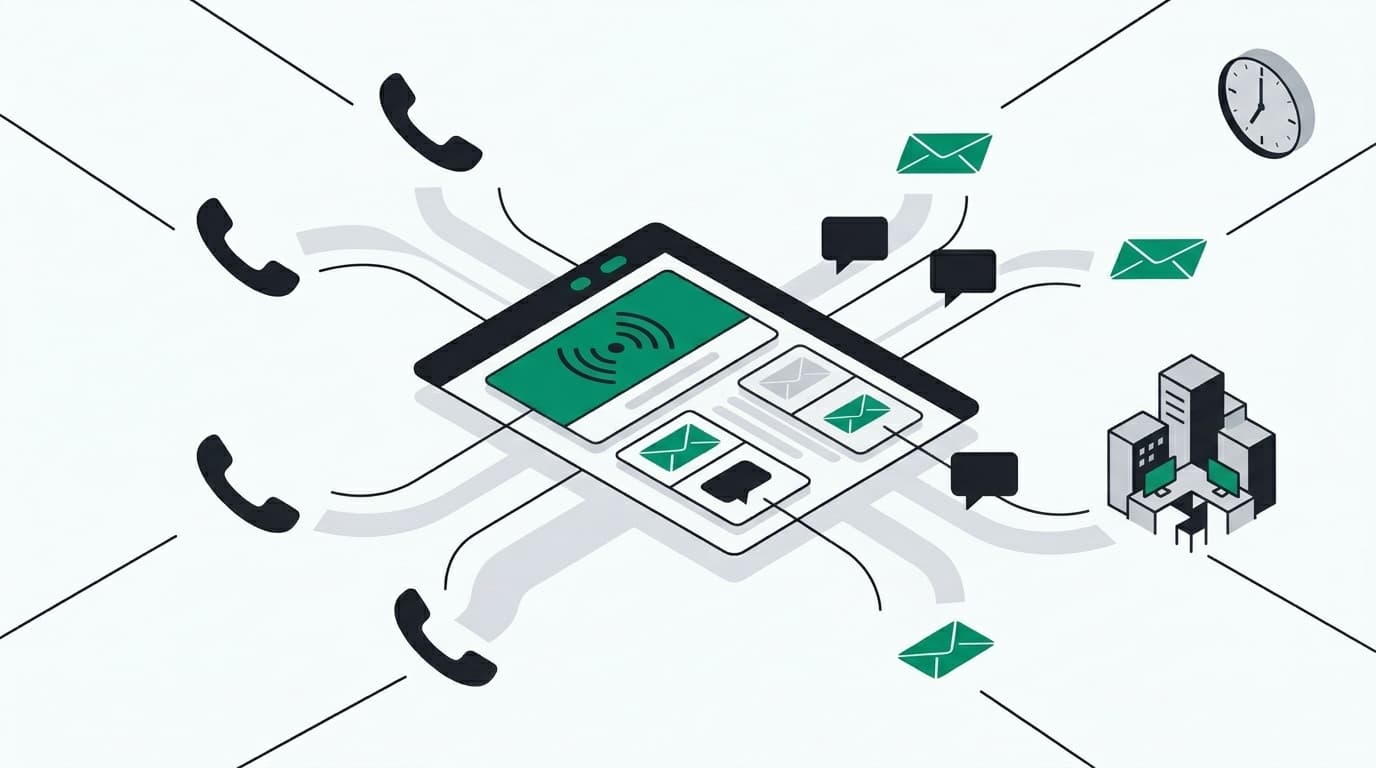
A different path: the call that comes in at 7 PM is answered by an AI assistant that talks to the caller, asks the right qualifying questions for the type of inquiry, and captures the conversation as a structured record. The caller never reaches voicemail. Your team gets the full context by morning.
That solves the revenue problem.
The deeper effect is what the records start to enable. Every call becomes a queryable artifact. The third repeat inquiry about the same policy question is a row in your database, not a tribal memory in one operator's head. The pattern surfaces because the records exist. The operation starts to see itself.
This is the work that turns a service company into a system that can be asked questions about its own operation. The after-hours assistant is one wedge. The same logic applies to every channel where signal currently goes uncaptured.
A scenario
A property management company managing 300 units handles roughly 12 calls a night after 5 PM. With voicemail, those calls produce essentially zero structured records. With an AI assistant capturing calls conversationally and routing by type:
- Emergency maintenance calls escalate to the on-call rotation in real time
- Prospective-tenant inquiries are scheduled for showings and saved against the unit they asked about
- Routine maintenance requests are queued with full context for the morning
The revenue effect is visible the first month. The signal effect compounds over the year. After six months, the operations team can ask which unit attracts the most after-hours interest, which type of maintenance issue spikes on which weeknight, which prospective-tenant questions keep recurring. None of this was visible before because none of it had been captured.
What the cost number actually is
The missed revenue from unanswered after-hours calls is a number a CFO can defend. The cost of a year of unanswered after-hours operational signal is harder to put on a slide — but it is the larger number. It shows up as the slow drift of an operation that knows less about itself than it could.
The reason to capture after-hours calls is not to recapture every voicemail's revenue. It is to stop leaking the signal that would have explained what the company actually needs to fix.
If your operation is leaking the signal it could be capturing, let's talk.