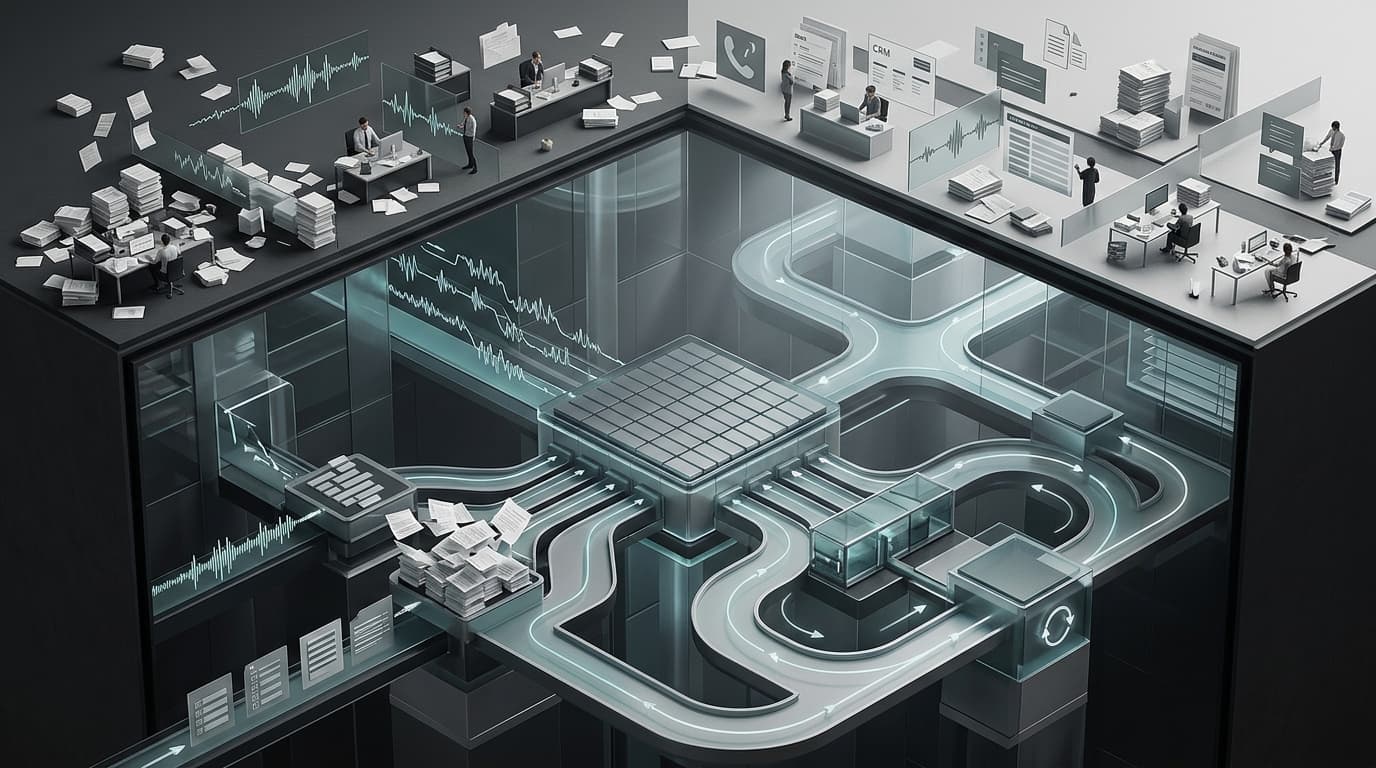
McKinsey's 2024 Global Survey on AI tested twenty-five organizational attributes against measurable EBIT impact from generative AI. The single largest factor was not the model in use, the size of the data team, or the budget allocated. It was whether the company had fundamentally redesigned at least some workflows around the technology.
Twenty-one percent had.
More than eighty percent of respondents reported no tangible enterprise-level EBIT impact from their gen AI use. One percent of executives described their rollouts as mature.
The three numbers tell one story. The thing that produces returns is the work most companies skipped.
The structural reading
For a year and a half, the AI conversation has lived at the wrong layer. Boards asked which model. Vendors asked which workflow tool. IT asked which API. The McKinsey finding cuts under all of it. The lever is not in the model layer or the tooling layer. The lever is in the operation itself — whether the work has been redesigned so AI has a sensible job to do.
Workflow redesign is not a euphemism for "buy a new product." It is the act of looking at the existing process, naming what is broken, redesigning the flow, and only then introducing AI into the redesigned version. The order is non-negotiable. AI on top of a broken process amplifies the dysfunction; it does not repair it.
This is what the McKinsey data says when you read it structurally. Most companies did the install without doing the rewire. The install produced no enterprise return because there was no rewired operation underneath it for the install to act on.
The practitioner voice
Tim Crawford and Isaac Sacolick, both senior CIO advisors, made the same case on a recent CXOTalk episode in different words.
Crawford on the divide between transformational and traditional CIOs: "A CIO is not a CIO is not a CIO." The transformational CIO has the rewire underway. The traditional CIO is, in his phrase, "absolutely drowning."
Sacolick on why pilots stall when they try to scale: "Even when you have a pilot you think is working — and now you're saying I'm going to take it from one team in New York doing marketing and apply it in six other businesses or four other departments — we don't know how to do that very well." The change-management gap is what kills the scale-out, not the technology.
Both arrived at the same place the McKinsey data points to. The deployment is the visible part. The redesign is the part that produces the return.
The counter-evidence
It is worth naming what the data shows when the rewire is skipped.
A study by the nonprofit METR found that AI made software developer tasks take twenty percent longer, not shorter, when introduced into existing workflows. Apollo Global Management's chief economist reports no profit margin lift outside Big Tech. Gartner has documented that AI-driven layoffs are failing to generate the returns the layoff thesis predicted. Surveys show roughly eighty percent of white-collar workers refusing AI adoption mandates outright.
These are not arguments against AI. They are arguments against AI without the rewire. The data points are not random — they cluster around the same structural failure. AI sitting on top of a process designed for something else does not transform the work. It makes the work harder and more expensive.
What the rewire actually looks like
A Y Combinator partner described in early 2026 what a redesigned workflow looks like once it is running.
An agent answers a specific class of internal queries from a database. A monitoring agent watches every query the team makes and notes which ones fail. A third agent writes the code to fix the failures, opens the pull request, and ships it overnight. The next morning, the same query that failed yesterday succeeds. The system has improved itself between sleep cycles.
The shape matters. The architecture is not a single tool. It is a loop — execution layer, evaluation layer, improvement layer — all in service of a defined outcome. The work has been redesigned around the assumption that intelligence is now an input the operation can consume.
Most service companies have nothing of the shape. They have a CRM, a phone system, a claims platform, and a stack of pilots. The pilots are not loops. They are point installations on top of unmodified processes.
The service-company translation
The foundation behind a working AI demo is not glamorous. It is the part of the work that took a year and is invisible from outside.
Calls transcribed. Documents text-extracted. Decisions captured as structured outcomes rather than as emails. Time attributed to specific operational entities. Cadences instrumented to produce data as a byproduct of running, not as a separate engineering project. Permissions and audit holding the trust layer in place.
This is the work that turns an existing service company into one that can absorb AI as a real input. None of it requires AI to do. All of it makes AI possible afterward.
The two-decade lesson from the data-lake era is the same lesson the AI era is now rediscovering. The lake was never the value. The act of structuring the company so the lake could be used was the value. AI is no different. The model is fast once the operation is ready for it. Almost nobody has gotten the operation ready.
The position
The companies that produced enterprise EBIT impact from AI are the twenty-one percent that did the redesign. The companies that produced no impact are the seventy-nine percent that skipped it. There is no third group in the data.
If you have run an AI pilot and it stalled, the diagnosis is almost certainly not the AI. The work that was supposed to happen before the pilot did not happen.
That is the work.