If you want AI results, start with one line item
Most service-company leaders we speak with are living in the same contradiction:
- AI spend is up.
- Internal decks are full of pilots and proofs of concept.
- But the P&L looks almost unchanged.
Recent research puts hard numbers on why.
Boston Consulting Group’s latest AI Radar 2026 finds that:
- 73% of CEOs now say they are the main decision-maker on AI in their organization – double last year.
- AI spend has roughly doubled to ~1.7% of revenue.
- Yet only a minority of companies are seeing clear, repeatable business impact.
Underneath that, one ratio stands out.
BCG splits CEOs into three groups:
- Followers – cautious, pilots only.
- Pragmatists – ROI-driven, use case by use case.
- Trailblazers – redesign entire workflows and business models.
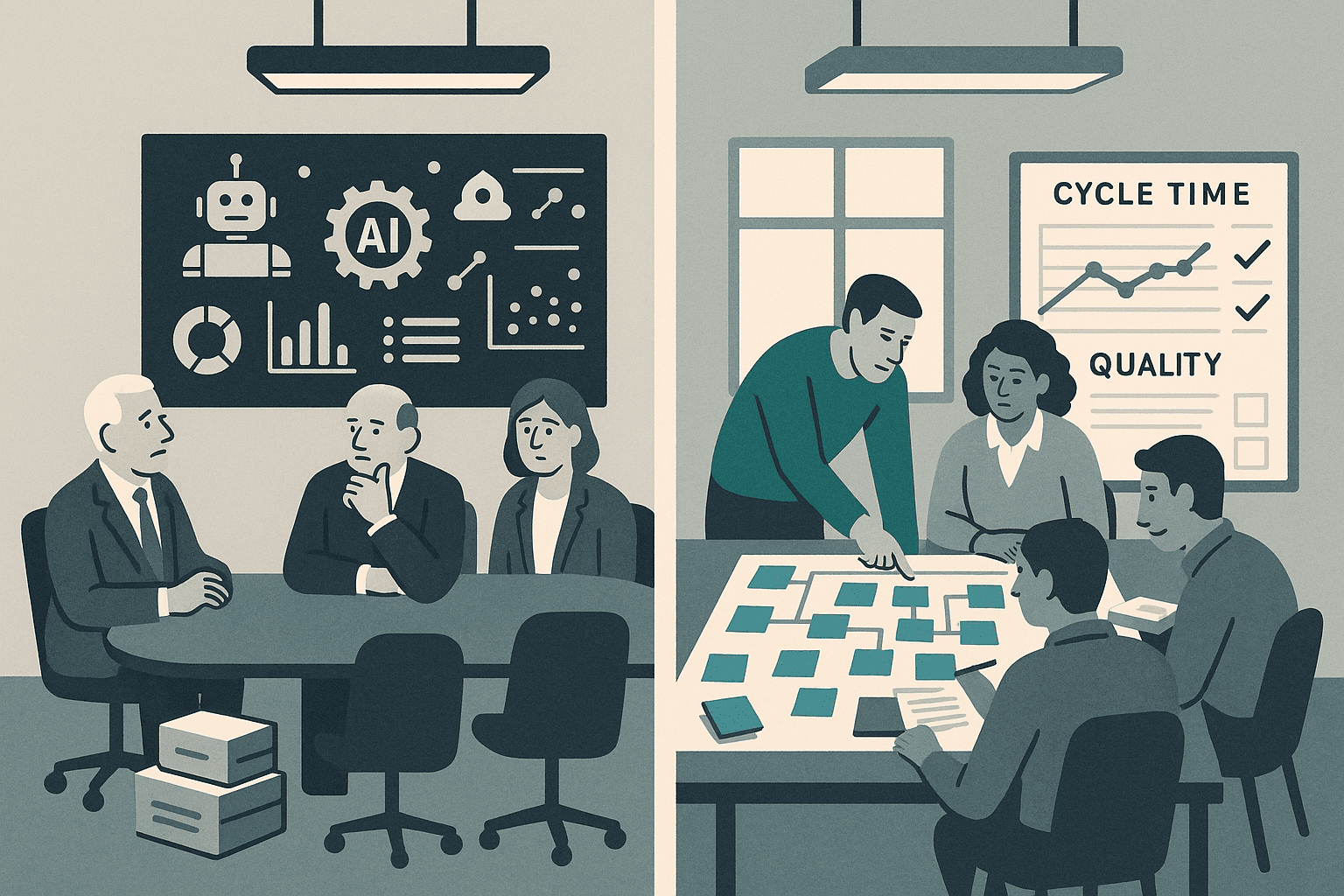
The difference between Trailblazers and everyone else isn’t tools. It’s where their AI budget goes.
- Trailblazers put about 60% of their AI budget into workforce development.
- Pragmatists put 27%.
That is the 60/27 test. It’s the simplest way we’ve seen to distinguish a company that is serious about AI from one that is narrating.
If you’re a CEO of a 50–500 person service company, this test matters more than your model choice.
The proof gap is real – and it’s widening
BCG is not alone.
Grant Thornton’s AI Impact Survey reports that:
- 78% of leaders lack confidence they could pass an independent AI governance audit within 90 days.
- Only 12% say their workforce is truly AI-ready.
- Companies that have fully integrated AI into operations are nearly 4× more likely to report AI-driven revenue growth than those still piloting (58% vs 15%).
PwC’s global CEO work (cited in Glenn Gao’s State of AI for CEOs briefing) adds another layer: 56% of CEOs report “absolutely zero” financial benefit from their AI initiatives, while 12% are pulling away with meaningful revenue gains and cost reductions.
Across these studies, three facts line up:
- Most boards have approved major AI investment.
- Most workforces are under-trained and under-prepared.
- The companies doing the hard integration work are already seeing several times the revenue impact.
In other words: the money is going into tools and projects; the capability is not landing in how people actually work.
Why the 60/27 test matters more than your model choice
Service companies are especially exposed to this dynamic.
Your product is how your people handle:
- Claims, tickets, and requests
- Estimates and proposals
- Project delivery and handoffs
- Billing, collections, and reporting
IBM’s 2026 CEO Study calls out how fast responsibility is moving:
- 69% of CEOs say AI is already changing what they consider core to the business.
- 77% say technology and talent leadership are converging.
- 76% report having a Chief AI Officer in 2026, up from 26% in 2025.
At the same time, IBM’s AI-first CEOs expect the share of operational decisions made by AI without human intervention to nearly double, from 25% today to 48% by 2030.
Put bluntly, AI is moving into the middle of how work gets done and how decisions get made. But it does not install itself.
If you treat AI as a software purchase, your budget will tilt towards licenses, pilots, and vendors.
If you treat AI as an operating-model shift, your budget will tilt towards retraining, redesigning workflows, and building governance into the way your people actually work.
The 60/27 split is not about being generous with training. It is the difference between:
- Teams who can safely redesign their own workflows with AI, and
- Teams who wait for someone else’s tool to tell them what to do.
One reliably compounds. The other stalls.
How to run the 60/27 test in your own company
You don’t need a consulting project to apply this. You need an honest look at your spend and a few clear decisions.
Step 1 – Look at last year’s AI spend as a whole.
Include:
- AI software and platform licences
- External vendors and consultants
- Internal AI-related salaries and contractors
- Cloud and infrastructure clearly tied to AI work
- Formal training and enablement programs
Then ask your finance lead to split that into three buckets:
- Tools & infrastructure – licences, models, cloud, integration work.
- People & capability – training, coaching, time explicitly allocated to redesign workflows, hiring for new skill-mix.
- Governance & measurement – monitoring, audit, documentation, risk work, and the people who own it.
Now calculate: what percentage went into bucket #2 (people & capability)?
- If you are at or above 60%, you are behaving like BCG’s Trailblazers.
- If you are between 25–40%, you are in the Pragmatist band.
- If you are under 25%, you are likely funding tools and theater, not capability.
This is the 60/27 test.
The absolute dollars matter less than the shape. A mid-market firm spending 0.7% of revenue on AI can out-execute a larger rival spending 2% – if more of their spend lands in people and workflow redesign.
The operating questions only the CEO can answer
Once you see your own ratio, the next move is not “more training days.” It is a different set of questions from the top.
From the recent Naviant CEO piece Beyond the Pilot: What CEOs Need to Own About AI in 2026, four questions belong to the CEO personally:
-
Are we shifting from tools to workflows?
Your teams should be talking about redesigning claims intake or project kickoff, not “rolling out a chatbot.” -
Have we elevated AI agents to the operating-model level?
In practice: when you review a process, do you ask “what should the agent do here, what should the human do?” If not, AI is still a sidecar, not part of the engine. -
Is every initiative tied to a measurable business outcome?
Cycle time, error rate, gross margin, customer retention. Dashboards of prompts and tickets don’t count. -
Is governance built in, or bolted on later?
Grant Thornton’s 78% audit-confidence gap exists because most firms launched AI into production and only then asked compliance to catch up.
These are not IT questions. They sit squarely in how you run the company.
Turning budget into capability: a practical 12‑month shift
If your 60/27 test shows you in Pragmatist territory or below, you don’t have to rewrite your entire budget. You do need to change its shape.
A simple 12‑month sequence we see working in service companies:
1. Pick one workflow that is both painful and measurable
Good candidates:
- Claims or ticket triage
- Quote or proposal production
- Invoice processing and dispute handling
- Standard reporting packs for clients
The test: you can write down the current cycle time, error rate, and touch count today.
2. Fund a cross-functional redesign team
Give a small group explicit time (not evenings and weekends) to:
- Map the current workflow step by step
- Decide where AI should draft, where humans should decide, and where guardrails are non-negotiable
- Define the outcome metrics that matter (e.g., “average time from quote request to approved quote”).
Budget this as people & capability, not “IT project hours.” It should show up as part of your AI workforce line.
3. Build governance in from day one
Borrowing from board guidance like BoardMember’s TRUST framework:
- Triage – which decisions are material enough to deserve human sign-off?
- Right data – do we understand where training and reference data come from and who owns it?
- Uninterrupted monitoring – can we see what the agent actually did on a specific case?
- Supervising humans – who is accountable for reviewing exceptions and drift?
- Technical documentation – can we produce an audit trail in under an hour for a regulator or major client?
Design this into the workflow. Don’t ask legal to “add it later.”
4. Make training part of the project, not an afterthought
“Workforce development” is often code for sending people to a generic AI course. That is not what Trailblazers are doing.
In the companies that are seeing 4× revenue impact from integrated AI:
- Training is built around live workflows, not tools in isolation.
- Frontline staff are involved in designing prompts, exception paths, and escalation rules.
- Supervisors are trained to read the new metrics – for example, the ratio of agent-executed to human-executed routine tasks.
Grant Thornton’s 12% “AI-ready” workforce number isn’t about everyone being a prompt engineer. It’s about whether your people know how to work with AI inside the processes that drive your margin.
5. Update incentives and scorecards
Finally, align how you measure teams with the new operating model.
- If a team’s scorecard still rewards volume of activity rather than cycle time, quality, and margin, they will treat AI as an annoyance, not an asset.
- If leaders are praised for launching pilots rather than retiring old ways of working, you will grow a long tail of unsupported experiments.
AI doesn’t fix misaligned incentives. It exposes them.
What this looks like in a 200‑person service firm
A composite example from firms we’ve seen up close:
- 200 people, mostly in delivery, support, and back office.
- Revenue ~$40m, net margins hovering around 8–10%.
- AI line item of about $500k last year – tools, some consulting, a few small pilots.
Their first pass at the 60/27 test looked like this:
- Tools & infrastructure: 70%
- People & capability: 18%
- Governance & measurement: 12%
Result: lots of demos, very little persistent change.
They didn’t triple the budget. They rebased it:
- Committed to keep total AI spend roughly flat for 12 months.
- Moved budget from multiple overlapping tools into a single core stack.
- Reallocated those savings into:
- A dedicated cross-functional redesign team for two workflows (quote production and invoicing).
- Protected time for team leads to participate in design and training.
- Basic monitoring and documentation so they could explain what their new agents were doing.
Twelve months in, without adding headcount:
- Quote turnaround improved from 5 days to under 36 hours.
- Invoice dispute cycle time dropped by 40%.
- Net margin moved from 9% to just over 12%.
Nothing magical. They simply behaved more like the 60% Trailblazers than the 27% Pragmatists.
The uncomfortable but necessary close
BCG reports that 50% of CEOs believe their job is on the line if AI doesn’t pay off. IBM finds 69% say AI is already changing what they consider core.
Given those stakes, it’s tempting to respond with more pilots, more tools, and more vendor meetings.
The evidence from BCG, IBM, Grant Thornton, and PwC points somewhere else:
- The companies pulling ahead are not the ones spending the most on AI.
- They are the ones spending a majority of that budget on people, workflows, and governance – and holding themselves accountable for integrated results, not experiments.
If you want to know which side of that divide you are on, you don’t need another strategy deck.
You need to run one test:
What percentage of our AI budget last year went into our people, their workflows, and the way we govern their new tools?
If the answer is closer to 27% than 60%, the question is not whether AI will deliver for your company.
The question is whether you are willing to rewire the budget, and the operating model, so that it can.