The signal that never makes it into the database
Every service company has the same complaint pattern recurring through customer calls. Three customers a week mention the same thing about the way claims are explained. Two name a billing line item that nobody on the operations side has noticed yet. The complaint exists. The pattern exists. And almost nowhere does it land as structured data anyone can query.
This is not a sentiment problem. It is a data problem. Service companies have built their operations on technology that takes the real world and keys it into tabular form — fields, dropdowns, structured records — so that it can be queried and reported on. Phone conversations don't fit the form. Decisions made in hallways don't fit. The unstructured majority of how a service operation runs has stayed invisible to its own systems for decades.
The result is what nearly every CEO already feels — an intuition that important signal is somewhere out there, no real way to surface it, and quarterly surveys that confirm what the leadership team already vaguely knew.
Why prior feedback approaches have failed
The standard menu hasn't worked.
- Post-call email surveys — 5% response rate. Sent hours later. The moment has passed.
- Manual follow-up calls — nobody has time. Calling to ask "how was your call?" feels awkward on both sides.
- Quarterly satisfaction trackers — by the time the data is summarized, the operational reality that produced it has shifted.
- No feedback at all — problems surface through escalations or churn, not in time to prevent either.
Every one of these approaches has the same root failure: it tries to bolt structured capture on top of a process that wasn't designed to produce structured records. The call already happened. The conversation already had the signal in it. Nothing remembered it.
A wedge into the foundation problem
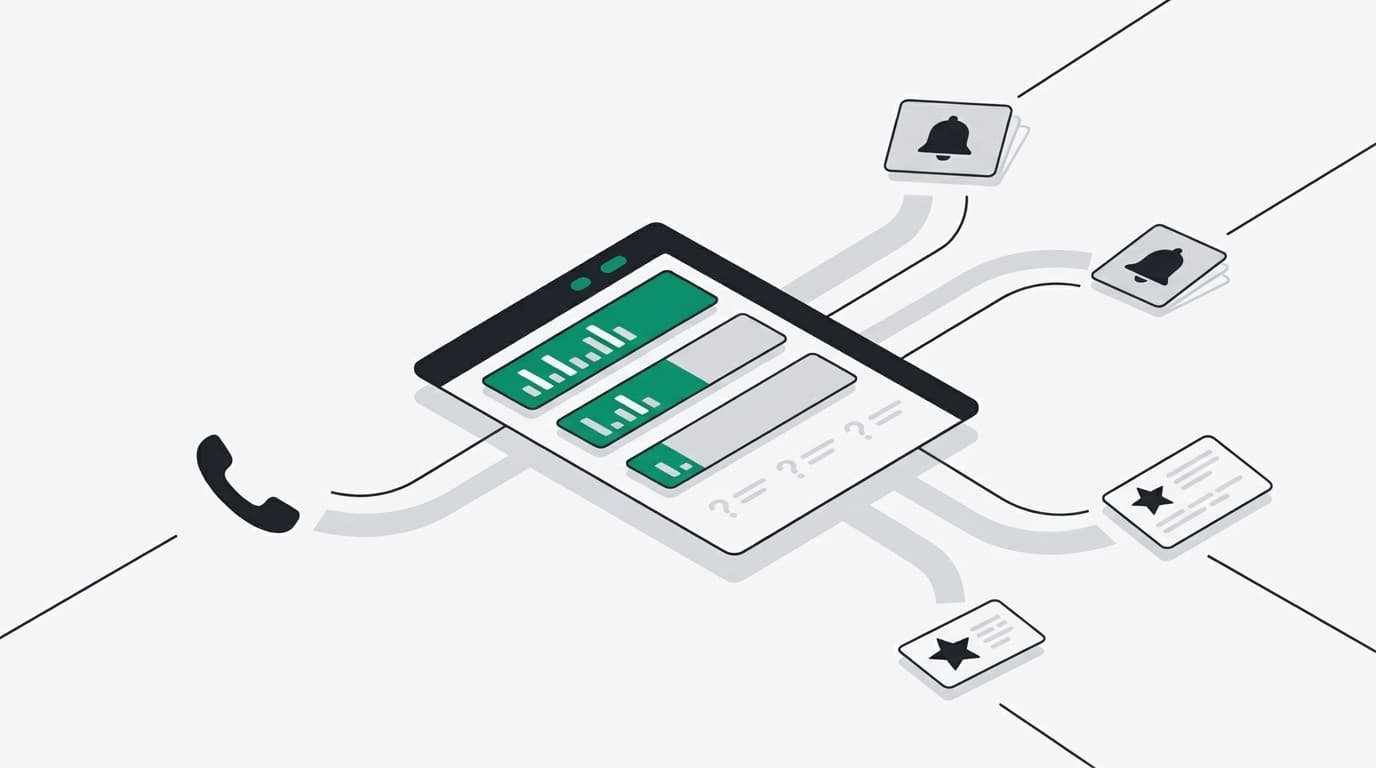
One of the cleanest wedges into this gap is the post-call survey, configured properly. Not the generic "press 1 for satisfied" menu. A short conversational ask captured at the moment that matters most — while the customer is still on the phone and the experience is fresh.
The structure looks like this:
- The agent finishes the call and asks if the customer will spend two minutes on a feedback question
- If yes, the call transfers to a short conversational flow — three questions, voice or keypad, customer chooses
- AI transcribes voice responses
- Results are saved against the call, the agent, and the topic — structured records, in your database
- Patterns surface across the agent, across the week, across the topic
Response rate moves from 5% to 30%+ because the moment of capture is right. But the response-rate gain isn't the real prize.
What the structured record actually unlocks
The prize is the company starting to see its own operation. When the post-call survey runs continuously, the feedback signal becomes queryable. The operations manager can ask: which topic drives the most low scores? Which agent is consistently struggling with which kind of question? Which time of day correlates with the worst experiences? The questions get specific because the data finally allows them to.
That is the difference between a feedback program and a feedback record. Most service companies have spent a decade trying to launch a feedback program. The change worth making is starting to keep a feedback record — structured, continuous, queryable.
What changes when you have the record
A service operation with structured customer-feedback records can do things that look like sorcery to operations without them.
- Identify the recurring topic driving 40% of low scores, without anyone summarizing calls by hand
- Spot the agent who needs coaching three weeks before quarterly reviews would have surfaced it
- Route highly-satisfied customers to public-review requests, generating durable trust as a byproduct
- Watch the trend by topic over months instead of guessing
None of this requires a new operating philosophy. It requires the data to exist. And the data only exists if the moment of capture is built into the call instead of attempted afterward.
The takeaway
Customer feedback doesn't have to be a quarterly project. It can be a continuous, automated record — captured at the moment that matters most, structured to be queried, fed into whatever operational decision needs it. The foundation is what makes everything else possible. Skip it, and every AI initiative on top of it produces one demo and then plateaus.
If you're curious what the customer-signal layer would look like in your operation, let's talk.