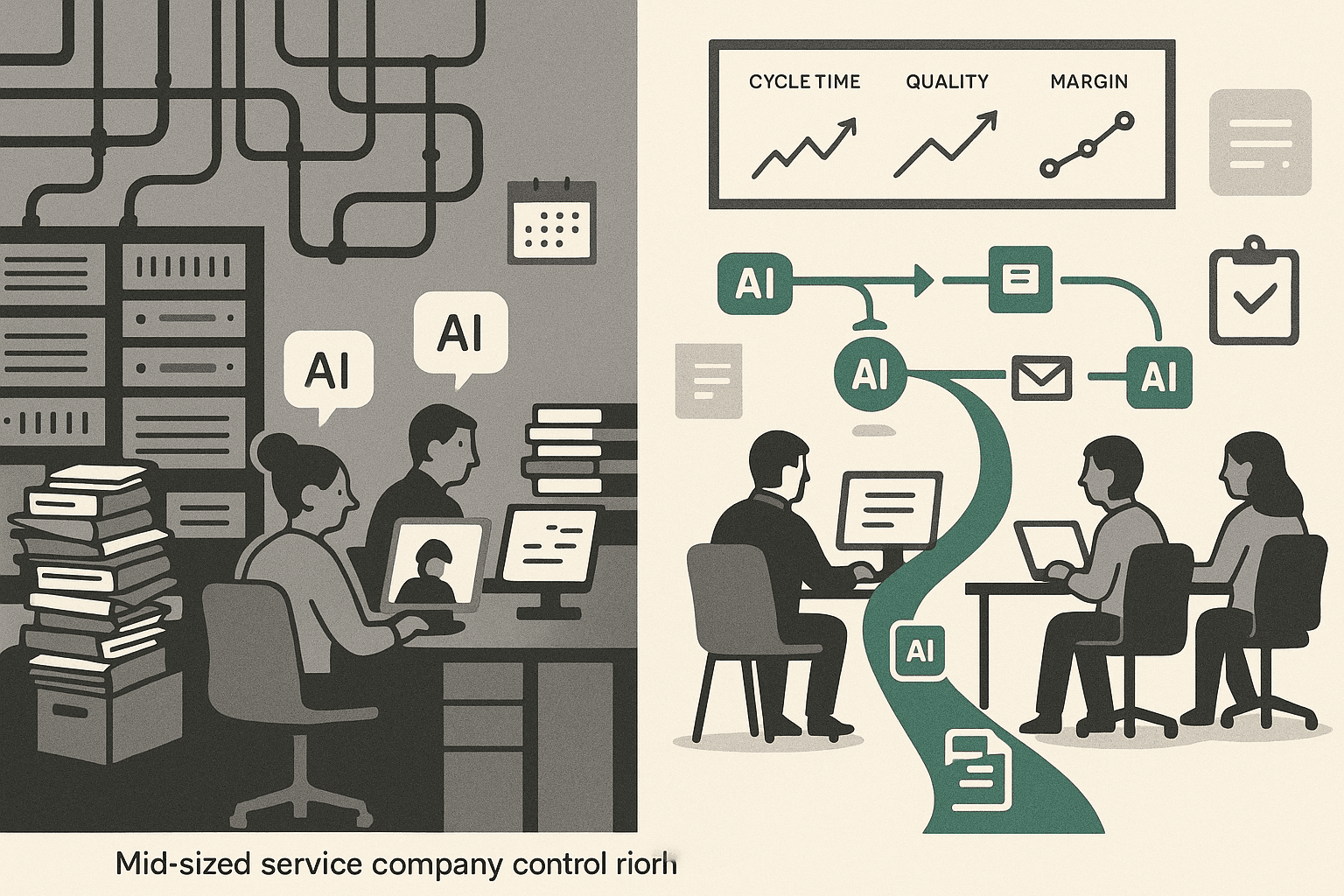
The inversion nobody expected: mid‑market is now ahead
For twenty years, the pattern was predictable: big enterprises experimented with new technology first, mid‑market followed later with a safer, cheaper version.
That pattern just broke.
A recent State of Agentic AI report says mid‑market AI deployment reached 67% in Q2 2026, up from 49% in Q1 and 28% in Q3 2025. Another mid‑market AI analysis calls this “an inversion of historical patterns” – mid‑market is now ahead of large enterprise on real AI deployment, not behind.
The explanation is practical:
- Enterprises are weighed down by legacy infrastructure, multi‑year cloud migrations, and decades of technical debt.
- Mid‑market firms often run on spreadsheets and lighter systems – what they call “Excel as strategic flexibility” – and can plug in cloud‑native AI without first untangling a decade of integrations.
- Decision‑making is faster: mid‑market CEOs and COOs can move from idea to pilot in weeks instead of quarters because they don’t need to route every decision through a matrix of middle management.
For a 30–500 person service company, that should change how you see yourself:
- You’re not an AI latecomer waiting for Fortune 500 playbooks.
- You are the segment with the structural advantage – if you use it.
The question is no longer “Can we deploy AI?” The question is “Will we turn that head start into a better operating model, or into a bigger mess?”
Why “more tools” is not the win
The same batch of research surfaces a hard truth from IBM, Bain, and the AI-native services market: the companies pulling ahead are not the ones with the most AI tools – they’re the ones that rewired how work runs.
IBM’s 2026 CEO Study puts numbers on the shift:
- 69% of CEOs say AI is already changing what they consider core in the business.
- 77% say talent and technology leadership are converging.
- 76% report having a Chief AI Officer in 2026, up from 26% in 2025.
- CEOs expect the share of operational decisions made by AI without human intervention to rise from 25% today to 48% by 2030.
Bain’s write‑up of IBM Think adds a crucial layer: the agenda has moved “from AI pilots to an operating model.” IBM’s own client‑zero story claims $4.5B in productivity unlocked over three years by changing how decisions, workflows, and governance operate – not by swapping models.
A recent AI‑Native Services Playbook makes the same point from the investor side. It warns founders about “Mirage PMF” – revenue growth that looks like product‑market fit but is actually just more humans working harder under an "AI‑powered" label. Its test:
“You only truly have it when AI is doing a material share of the work at a high gross margin and delivering superior customer outcomes. Otherwise, you've built a good services firm financed with the wrong kind of capital.”
Translated to your world: if your margins, staffing curve, and cycle times haven’t meaningfully changed, your AI is probably a slide, not a system.
Mid‑market’s real advantage: you can change the operating model
The mid‑market advantage is not that you can buy tools faster. It’s that you can change how work runs faster.
Three shifts define that operating‑model change:
1. From “AI as assistant” to “AI does a slice of the work”
The AI-native services playbook compresses the workforce decision into four words: “Automate tasks, not people.” FM Global’s SVP of Claims, Jeremy Galant, shows what that looks like in practice on an insurance claims floor:
- Claims cycle time fell from 180 days to 90, with a clear path to 60 days for small losses.
- They’re “saving about 300% of adjuster hours” by automating the routine FastTrack claims.
- Humans still make the decisions; AI handles the admin and the pattern‑repeat work.
That is not a chatbot bolted onto the call center. It’s a redesign of who does what in the workflow.
For a field‑services company, a logistics operator, or a BPO, the analogues are obvious:
- Document intake and validation
- Dispatch and routing
- QA sampling and exception review
- Routine status updates and notifications
If AI is only summarizing meetings and drafting emails, you’re leaving the mid‑market advantage on the table.
2. From hours and tickets to “how much work did AI actually do?”
One AI-native legal-services company tracks HURT – Human Review Time – as its north‑star metric. They measure:
- How much time humans spend reviewing AI work
- How fast that review time drops as the system learns
IBM’s research echoes this: they find AI leaders are those who measure outcomes, not activity – cycle time, error rates, first‑time‑right, net margin – and then ask a simple question: what portion of this outcome is now delivered by AI?
For a service‑company COO, that suggests a different dashboard:
- % of routine tickets fully handled by AI
- Minutes of human review per AI‑handled case
- Cycle‑time shift where AI is embedded vs where it's not
Those numbers tell you whether you’ve moved beyond “Mirage PMF” into real leverage.
3. From “tools we bought” to “data we own”
A managed-services industry analysis lands on a blunt line:
“Your biggest asset is no longer your service catalog — it's your operational data, which fuels predictive and autonomous capabilities.”
Across the strongest sources in the batch, the point is consistent: the moat is the memory of how your operation actually runs.
- Every dispatch, ticket, quote, and claim builds that memory.
- If that data lives only in vendor systems and scattered PDFs, the vendor owns the learning curve.
- If you structure it – and permission it – you own the compounding effect.
That is the mid‑market move enterprises struggle to make because their data is so fragmented.
The clock that mid‑market can’t ignore: governance goes live
While mid‑market pulls ahead on deployment, the governance enforcement clock is starting to tick:
- Colorado AI Act takes effect June 30, 2026, requiring documented risk assessments, safeguards against algorithmic discrimination, and ongoing monitoring for high‑risk AI systems.
- EU AI Act obligations for high‑risk systems start phasing in from 2026–2027.
- California’s automated decision‑making rules require risk assessments from January 1, 2026, with full enforcement from January 1, 2027.
- The SEC has named AI‑driven threats to data integrity as a 2026 examination priority.
- Cyber insurers are beginning to require AI‑specific controls and red‑teaming as conditions for coverage.
A 2026 AI data-governance forecast shows how unprepared most companies are:
- 78% cannot validate data before it enters AI training pipelines.
- 77% cannot trace where training data came from.
- 53% cannot recover training data after an incident.
At the same time, DTEX and Ponemon find 92% of organizations say GenAI has already changed information sharing, while only 13% have integrated AI into business strategy. A 7:1 gap between disruption and management.
For a mid‑market service company, that creates a narrow but powerful window:
- You are small enough to get your arms around your AI use, inventory, and data flows now.
- You are big enough that regulators, customers, and insurers will soon expect you to have done it.
IBM and Bain are explicit: governance is moving from policy documents to runtime controls – identity, permissions, logging, and audit inside the systems that do the work.
If your AI today is:
- A set of chatbots with unknown data access
- A few “agents” wired into production systems with no audit trail
- Shadow tools individual teams adopted on their own
…you are using your mid‑market agility to create risk faster, not value faster.
Turning advantage into a plan: a mid‑market operating-model play
Pulling these threads together, a service‑company CEO or COO can treat 2026–2027 as a two‑year window to do three things:
1. Pick one workflow where AI should measurably change the scorecard
The best candidates share three traits:
- High volume and repetition (claims intake, invoice processing, scheduling, tier‑1 support)
- Clear outcome metrics (cycle time, errors, recovery, NPS, cash collected)
- Contained regulatory surface (one regulator, one set of rules)
In regulated back‑office workflows, the stronger pattern is to pick one workflow – for example, small‑loss claims – and design backwards from the audit:
- For claim #4731, can you produce within 10 minutes:
- Prompt version
- Model version
- Input documents
- Evaluation result
- Human sign‑off (if any)
- Policy that was in force when the decision was made
If you can’t do that on a pilot, you won’t survive scaled deployment.
For your first AI‑heavy workflow, write down in plain language:
- What the workflow is supposed to achieve
- Which steps AI will do, which steps humans will do
- What must never be automated (materiality, not “confidence score”)
- What evidence you’ll need to show a regulator, auditor, or major customer
Then commit to measuring one thing: how much human review time per unit of work (HURT) and how that changes.
2. Build runtime governance into the design, not as an afterthought
Bain’s 1:120 statistic – one human identity for every 120 non‑human identities (agents, services, automations) – tells you why spreadsheet access lists and static roles will not survive.
The trust rule is simple: your orchestration layer must ensure AI systems don’t leak information across users or workflows.
For a mid‑market service company, runtime governance comes down to a few concrete decisions for each AI‑touched workflow:
- Identity: how do you distinguish between a human, an automation, and an external vendor system?
- Permissions: who (or what) is allowed to see, change, or act on customer data, employee data, and financial data in this workflow?
- Logging: can you answer “who/what did what, when, with which inputs” without reverse‑engineering logs from three tools?
- Decommission: under what conditions does this AI capability get shut off or retrained?
Jeff Clarke at Dell boils trust down to one sentence: “In an AI workforce, every action needs a receipt.” Mid‑market firms have the advantage that they can adopt this discipline in a few core systems now, instead of trying to retrofit it across thousands later.
3. Treat operational data as inventory – and build once, use everywhere
IBM, the AI-native services market, and managed-services research all land on the same conclusion: the data produced by your services is your primary asset.
Practically, that means:
- Every pilot should leave behind better‑structured operational data, not just a demo.
- Engagement letters and MSAs should give you rights to use data from the service to improve the service.
- New workflows should be designed so that what AI did, what humans did, and what happened are captured in a way other use cases can reuse.
One mid‑market analysis makes a hard prediction: 90% of AI vendors will not survive the next 24 months. If you let each vendor keep your operational data in its own silo, your learning curve walks out the door with them.
Mid‑market companies can do something most enterprises can’t: standardize on a small number of systems, ensure those systems emit usable logs and records, and build their own memory on top.
What to do in the next 90 days
For a CEO or COO of a service company, the concrete moves for the next quarter aren’t about buying more AI; they’re about using your structural advantage before it erodes.
- Name your first real AI operating‑model proof. One workflow, one outcome metric, one HURT target.
- Inventory where AI already touches customer, employee, or financial data. Shadow tools included. Draw a simple map: systems, data, people.
- Write a one‑page runtime‑governance standard you can apply to every new AI use: identity, permissions, logging, decommission criteria.
- Shift one scorecard from activity to outcome. For that first workflow, stop counting tasks and start measuring cycle time, error rates, and share of work done by AI.
- Decide who owns “intelligence management.” Not in IT alone. A named operator who understands the work and will be accountable for how AI reasons, decides, and escalates.
The mid‑market is now moving faster than enterprise on AI deployment. The regulators are starting to move. Vendors will churn.
The companies that win this inversion will be the ones that use their agility to change how the work runs and how it’s governed, not just how many tools they subscribe to.