The new AI divide: same tools, different outcomes
If your leadership team feels like AI is “everywhere but not working here,” you are not alone.
Across banking, professional services, and the mid-market, a consistent pattern is now visible:
- Adoption is exploding. JPMorgan Chase, using its own transaction data, finds small-business AI adoption jumped from 5.2% to 17.7% between 2023 and 2025, with the 2025 cohort reaching 10% adoption in 6 months vs 77 months for the 2019 cohort — roughly 13× faster.
- Results are not. An MIT-linked NANDA study reports 95% of organizations deploying GenAI see no measurable return when “success” is defined rigorously (sustained productivity + documented P&L impact, verified by both users and executives). RAND decomposes an 80.3% AI failure rate into projects abandoned before production, projects that reach production but create no value, and projects that never recoup their cost.
And the most important part: when these studies explain why AI fails, they almost never blame the model.
Brookings, JPMorgan, Capgemini, and multiple practitioner sources all land on the same conclusion:
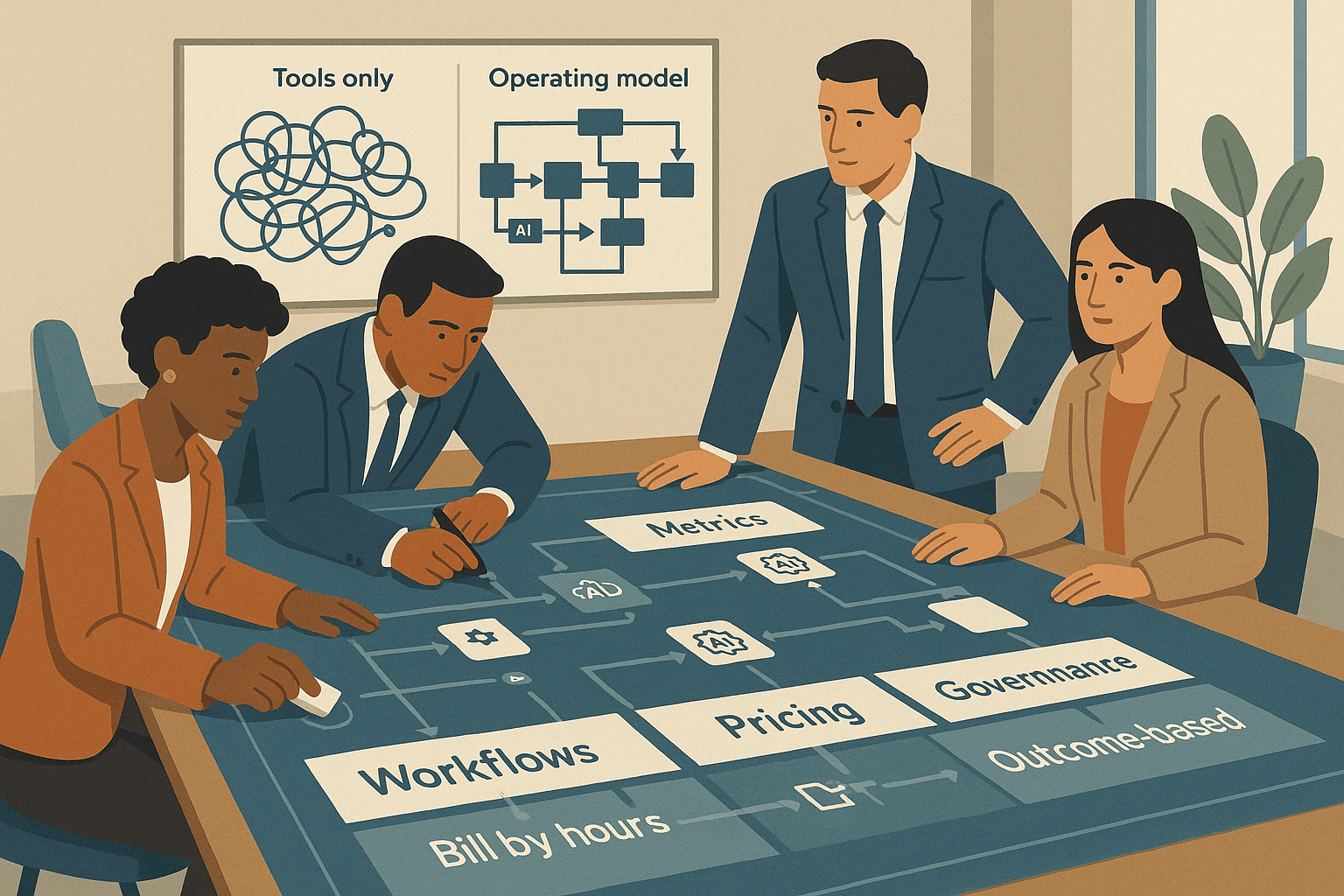
The differentiator is not whether you adopt AI, or which model you pick. It is whether you redesign your operating model so AI has something coherent to plug into.
For service companies, this is good news. The barrier is less about budget and more about leadership decisions you control.
Evidence from the field: it’s the operation, not the tool
Several independent data sets now say essentially the same thing:
1. Integration depth beats adoption speed
JPMorgan Chase Institute looked at actual bank transactions, not surveys. As AI costs fell from ~$50/month to $20–30/month, adoption sped up dramatically. Yet their headline isn’t about adoption at all:
"Competitive differentiation may depend less on whether a firm adopts AI and more on how effectively it integrates AI into operations."
Two further findings are especially relevant for service firms:
- Capacity beats money. Small employer firms (those with staff) adopt AI more than large nonemployers. Access to human capacity to implement matters more than sheer capital.
- Knowledge-intensive leads. Information and professional-services firms are at ~30–40% adoption; construction and transport lag far behind. Firms that already run on codified processes are pulling away.
In other words: AI is now cheap to rent. The advantage moved to how well you absorb it into the way work actually gets done.
2. Organizational capacity, not access, drives gains
A Brookings analysis of AI and productivity introduces the "complements" thesis:
- Productivity gains accrue to firms that already have data quality, management capacity, skills, and redesigned workflows.
- “The main barrier is organizational capacity and complementary investments, not access.”
They also highlight something most board decks omit: the J-curve. Productivity often dips while you invest in data, process redesign, and training, then rises later. Leaders who expect immediate uplift shut projects down just as they reach the payoff.
3. Leadership decisions explain most failures
A mid-market advisory analysis of RAND and Gartner data breaks the 80.3% failure rate into three buckets:
- One-third abandoned before production
- Roughly one-third that make it to production but deliver no material value
- The rest that never recoup their cost
The root-cause patterns are uncomfortably familiar to most service executives:
- Data quality is a roles problem, not a tooling problem. Nobody is accountable for a consistent customer ID or case view across ERP, CRM, ticketing, and billing.
- AI initiatives are treated as technology projects, not organizational stress tests. When you add automation to a messy, multi-hand-off process, you don’t get efficiency — you get faster dysfunction.
- Ownership is fuzzy. Projects live between IT, operations, and a “tiger team,” with no single leader accountable for the gap between the demo and the production rollout.
Pertama’s research goes further: in their dataset, 84% of AI failures are leadership-driven. Yet organizations that kept sustained CEO sponsorship saw 68% success vs 11% without it — and they didn’t simply spend more. They spent differently: nearly half of their budget on foundations (data, process, training) instead of tools.
This aligns with Capgemini’s finding in insurance:
- Trailblazers that treat AI as a core operating capability — not a set of tools — achieved up to 21% higher revenue growth and ~51% greater share-price increase over three years.
- Yet 42% track no AI metrics at all, and 55% say it is unclear who owns AI initiatives.
The pattern is stark: technology is ready; operating models and management discipline are not.
The hidden lever: your pricing model
One new thread in the latest research hits where service firms feel AI most directly: the P&L.
Multiple sources converge on a simple but uncomfortable conclusion:
AI breaks per-seat and per-hour pricing. If you don’t change how you bill, you will give most of the benefit back to the client.
Several examples make this concrete.
When success erodes your revenue
Pilot, a financial-operations provider, offers a sharp litmus test for any AI-enabled service or product:
"If your product succeeds spectacularly, do customers need fewer of the thing you charge for? If yes, pick a different metric."
Their data:
- Seat-based pricing in SaaS has already fallen from 21% to 15% of contracts in 12 months.
- Per-seat AI products show ~40% lower gross margin and 2.3× higher churn.
This is exactly the trap many service firms are walking into with AI:
- If you bill by hour, and AI lets you finish in half the time, your revenue compresses unless you change the metric.
- If you bill by seat (e.g., “agents on the account”), and AI means you need fewer seats, the client’s CFO will push to shrink the contract.
Kallam’s work on AI economics in services puts it bluntly: under billable-hour models, AI is revenue compression; under fixed-fee or outcome-based models, it can be margin expansion.
The compensation trap inside your firm
In consulting and many BPOs, a second-order effect quietly kills AI incentives.
Innovaiden, analyzing why firms struggle to align people, services, and AI, describes the compensation trap:
“A partner whose team delivers a project 60% faster using AI does not earn more, they earn less, because the billings are lower.”
Partners aren’t wrong to resist changes that shrink their own economics. The problem is the metric: compensation is tied to input (hours billed) rather than outcome (value delivered, client results, account growth).
If you don’t address this, your best people will politely kill AI initiatives long before any model does.
What to do about it
For a service-company leadership team, three moves change the game:
-
Run the value-metric test on your own offerings.
- For each AI-affected service, ask: “If this works spectacularly, do clients need fewer hours, tickets, or seats?”
- If yes, those are the wrong billing units. You need to move toward metrics that grow when clients win: policies serviced, claims resolved, issues closed, revenue managed.
-
Align compensation with the new metric.
- If partner or manager bonuses are still primarily tied to hours, they will naturally protect hours.
- Shift a meaningful share of variable pay to outcome metrics: client retention, scope expansion, NPS plus cost-to-serve, or other measures that reward delivering more value with less effort.
-
Be explicit about the economic model of AI in your firm.
- Is AI primarily a margin expander, letting you deliver contracted outcomes with fewer inputs?
- Or is it primarily a capacity creator, letting your best people take on more complex, higher-value work while AI handles the routine?
Until you answer this at the board and compensation-committee level, AI will remain a pilot, not an engine.
Governance as advantage, not overhead
A second under-used lever is governance.
Many executives still hear “AI governance” and think “compliance cost.” But new data suggests the opposite: governance quality is strongly correlated with business outcomes.
Grant Thornton’s 2026 AI Impact Survey (950 leaders) finds that organizations with strong board oversight:
- Are 2× as likely to have fully integrated AI
- Are ~3× as likely to have deployed agentic systems
- Are 4× as likely to say AI is not underperforming
Yet only 11% of boards meet their bar for “strong oversight.”
A few practical shifts stand out:
From black box to “provably compliant”
Several sources converge on a new standard. As one governance leader summarized:
"Enterprise AI is probabilistic by design. Governance is deterministic by necessity… 'Provably compliant' replaces 'likely compliant.'"
Regulators and clients are moving from “do you have a policy?” to “show me the decision trail.” Ocean Tomo, looking at director liability and “AI washing,” reminds boards that under the “knew or should have known” standard, you will be expected to prove that AI-linked claims, efficiencies, or cuts were grounded in verifiable practice.
For service firms, this changes what “good AI” looks like. A clever chatbot that can’t produce an audit log of:
- What data it accessed
- Which tools it called
- Which rules or guardrails fired
- When and why it escalated to a human
…is now a risk, not an asset.
The CIO cannot fly solo
Grant Thornton also finds that a siloed, IT-only approach to AI underperforms. Operations, finance, HR, legal, and risk all have skin in the game:
- Operations care about throughput, quality, and handoffs.
- Finance cares about realized savings and revenue impact.
- Legal cares about provenance, bias, and duty of care.
- HR cares about redeployment, reskilling, and trust.
The organizations seeing returns have a named cross-functional owner for AI — someone with enough span of control to align these concerns and enough authority to say “no” to attractive-but-misaligned projects.
For many mid-market service firms, that role will be part-time and embedded, not a new stand-alone empire. But the responsibilities are clear: define where AI is allowed to act, what it can touch, how results are verified, and when humans must re-enter the loop.
How to turn this into an advantage in your firm
You don’t need a research department to act on this. You need a bias toward redesign over tooling.
Here is a practical sequence service-company executives are using to flip AI from distraction to advantage:
1. Stop asking “Where can we use AI?”
Start with two harder questions:
- “Who owns AI outcomes here?” If you can’t name a person and a metric, you don’t yet have an AI strategy; you have experiments.
- “Which three workflows, by exact name, should change outcomes this quarter if we apply AI?” Most leadership teams struggle to answer this specifically on the first try. That’s the point.
For a law firm, that might be: intake triage, first-draft contract review, and knowledge retrieval for associates. For a BPO, it might be: email triage, claims extraction, and exception handling.
2. Redesign the workflow before you deploy the tool
The firms that see returns follow a consistent pattern:
- Map the end-to-end workflow: what comes in, who touches it, which systems hold the data, how exceptions are handled, where clients get frustrated.
- Decide what “good” looks like: cycle time, error rates, first-contact resolution, cost per execution.
- Then decide where AI should:
- Fully automate
- Assist a human
- Only observe and suggest
This sounds obvious. But most “failed” AI projects shortcut this and jump straight to licensing and integration. As one Section AI advisor put it:
"AI investment is reallocation. If nothing gets cut, nothing meaningful changes."
If your AI project doesn’t delete steps, reassign ownership, or retire legacy reports and approvals, it’s unlikely to change the business.
3. Fix the metrics, then the pricing
Before you install another tool:
- Replace activity metrics (tickets handled, hours logged, “AI usage”) with outcome metrics (issues resolved, repeat-contact rate, time-to-resolution, cost per resolution).
- Run the value-metric test on how you bill and how you pay your people.
- If AI success reduces billable units, adjust your unit.
- If AI success isn’t visible in anyone’s scorecard or bonus, expect resistance.
Thomson Reuters finds that only 18% of professional-services firms track AI ROI, and another 40% don’t know whether it’s measured. Until you step into that 18%, you are managing by anecdotes.
4. Treat governance as a product feature, not a constraint
Finally, design your AI programs so you can answer three questions, at any time, for any client or regulator:
- What can our AI see? (Data domains, systems, and documents.)
- What is it allowed to do? (Actions, spend limits, approvals.)
- How do we prove what it did? (Logs, decision traces, human interventions.)
This isn’t bureaucracy. It is the basis for:
- Faster client onboarding (“Here is exactly how we use AI in your account, and how you can audit it.”)
- Safer experimentation (because you know the blast radius of a misbehaving agent).
- More defensible board and regulator conversations (“Here’s the evidence behind our efficiency claims.”)
Firms that build this muscle early will find that governance becomes a sales advantage, not a line item.
The takeaway for service-company leaders
The story emerging from the latest research is clear:
- AI tools are now cheap and widely available. Your competitors can rent the same models you can.
- Most AI projects fail for organizational reasons, not technical ones. Leadership, ownership, data, workflows, and incentives explain the gap.
- Pricing and governance are now strategic levers. If you keep billing by seats and hours and treat governance as a checkbox, you will donate most of AI’s gains back to your clients — or to your risk budget.
The firms that win the next decade in services won’t be the ones that “do the most AI.” They’ll be the ones that are willing to:
- Redesign work around AI instead of bolting AI onto broken work
- Change what they charge for and how they reward people
- Make integration depth, not adoption theater, the measure of progress
You don’t need another pilot to start that shift. You need to treat AI as a forcing function to build the operating company you’ll wish you had five years from now.