The governance problem most service companies are about to inherit
AI is already in your business—whether you planned it or not.
Employees paste client data into public tools. Vendors quietly add "AI assistants" into software you already use. A pilot chatbot now handles real customer conversations. A claims or dispatch workflow depends on a model no one on your team can describe.
On paper, you may even have an AI policy. But when a regulator, key customer, or insurer asks how you actually control all of this, the answers get thin fast.
Recent data points make the gap clear:
- Diligent reports that 60% of legal, compliance, and audit leaders now cite technology as their top risk, yet only 29% of organizations have comprehensive AI governance plans.
- Shadow-AI analysis shows that nearly 40% of data flowing into AI tools is sensitive or confidential, and roughly a third of ChatGPT usage runs through unmanaged personal accounts.
- Verizon's 2026 Data Breach Investigations Report finds that 48% of breaches now involve a third party, a 60% year-on-year jump.
At the same time, regulators and insurers are moving. Colorado's AI Act goes live this summer, the EU AI Act starts biting high‑risk workflows shortly after, and major carriers are beginning to ask for documented model testing and third‑party oversight in D&O and cyber renewals.
For a 50–500 person service company, this is not an abstract compliance story. It's a board‑level operating risk. And the decision in front of you is blunt:
Will you govern the AI already in your business—or inherit an ungrowvernable mess?
The rest of this article is about how to govern it in a way that supports growth instead of slowing you down.
Governance is not a binder. It’s how the work actually runs.
One of the strongest recent playbooks for AI governance comes from a community-bank regulator audience, but the logic applies cleanly to any service business.
Their starting point is simple:
“AI governance is not a document. It is a practice.”
They describe a familiar failure pattern: when the examiner arrives, the organization produces a thick AI policy, but cannot show any convincing evidence that the policy is actually used. The binder exists; the program does not.
Examiners, insurers, and sophisticated customers don’t start by asking, "Do you have a policy?" Their first questions are:
- Show me your AI inventory. What systems, tools, and vendors are using AI that can affect customers, employees, or money?
- Show me how you control vendor AI. If a key vendor changes their model tomorrow, how would you know, and what can you do about it?
- Show me how you handle an AI incident. When something goes wrong, how do you stop it, audit it, and fix it?
If you can't answer all three in about fifteen minutes with evidence, you don’t have a governance program. You have governance theater.
Watching is not enough: the containment gap
Many companies have responded to AI risk the way they responded to earlier tech waves: more monitoring, more dashboards, more “human in the loop.”
Those are necessary. They are not sufficient.
Survey data from recent governance work shows a consistent pattern:
- Around 60% of organizations have some form of monitoring or human review for AI outputs.
- But only ~40% have tested kill switches or isolation controls that can actually stop or contain a misbehaving system.
- Even fewer have purpose‑binding—technical limits that prevent an AI agent being repurposed for uses it was never approved for.
In other words, most organizations invested in watching AI, not in stopping it.
At the same time, a CIO.com feature on agent governance captured another blind spot: most enterprises have no inventory of the agents already running in production. SIEM and security tools are tuned to spot human anomalies; a hijacked agent that executes the same actions perfectly 10,000 times in a row looks like "normal behavior" in those systems.
This is the containment gap:
- You cannot govern what you haven’t inventoried.
- You cannot contain what you can’t stop within minutes.
For a service company, closing that gap is not an IT luxury. It is the difference between a contained incident and a reputational event.
The new AI risk no one owns yet: vendor-supplied AI
Even if you never build a model internally, you are still carrying AI risk through your vendors.
A senior security leader recently summarized it this way:
“The majority of AI exposure in most enterprises is not homegrown. It is embedded.”
Three patterns are now common:
- Silent feature creep – a vendor quietly adds an "AI assistant" or probabilistic scoring to a system you already use. The contract still describes rule‑based software.
- Shadow AI inside third parties – your outsourcers and partners use AI internally to handle your work, but you have no visibility into how those models are built, tested, or changed.
- Old questionnaires, new risk – traditional third‑party risk programs were built for security, privacy, and availability. They were not designed to handle model lifecycle, drift, training data rights, or explainability.
One governance essay framed the underlying problem as "accountability without control." If you benefit from the output of a vendor’s AI, you inherit responsibility for the impact, whether or not you built or can inspect the model.
The harsh corollary:
If you are relying on contracts and questionnaires to manage vendor AI risk, you are not transferring liability. You are accumulating it quietly.
For service companies, this shows up in practical places:
- A contact-center platform starts auto‑classifying sentiment and triggers refunds.
- A billing system uses AI to dispute or accept invoices.
- A field‑service platform starts optimizing technician routing using a model trained on other customers’ data.
In each case, if the AI behaves badly, the customer blames you, not your vendor.
What boards and CEOs should insist on: four operating disciplines
Treating AI governance as an operating problem—not a paperwork problem—leads to a different set of priorities.
Here are four disciplines that service‑company boards and CEOs should require, whether the AI is homegrown or vendor‑supplied.
1. Inventory before policy
You cannot govern what you have not named.
The first move is a live AI inventory, not another policy draft. At a minimum, it should list:
- Every internal system, workflow, or tool that uses AI to make or recommend decisions that affect customers, employees, money, or regulated outcomes.
- Every vendor product or service that relies on AI in a way that can influence your results—even if they market it as "just a feature."
For each line in the inventory, capture:
- Business owner
- Purpose (what decisions or tasks it influences)
- Data used (especially sensitive or regulated data)
- Human‑in‑the‑loop model (when and how people can override)
This is not a one‑time exercise. It needs an owner and a simple update process every time you buy, build, or materially change a system that uses AI.
2. Containment as a first‑class requirement
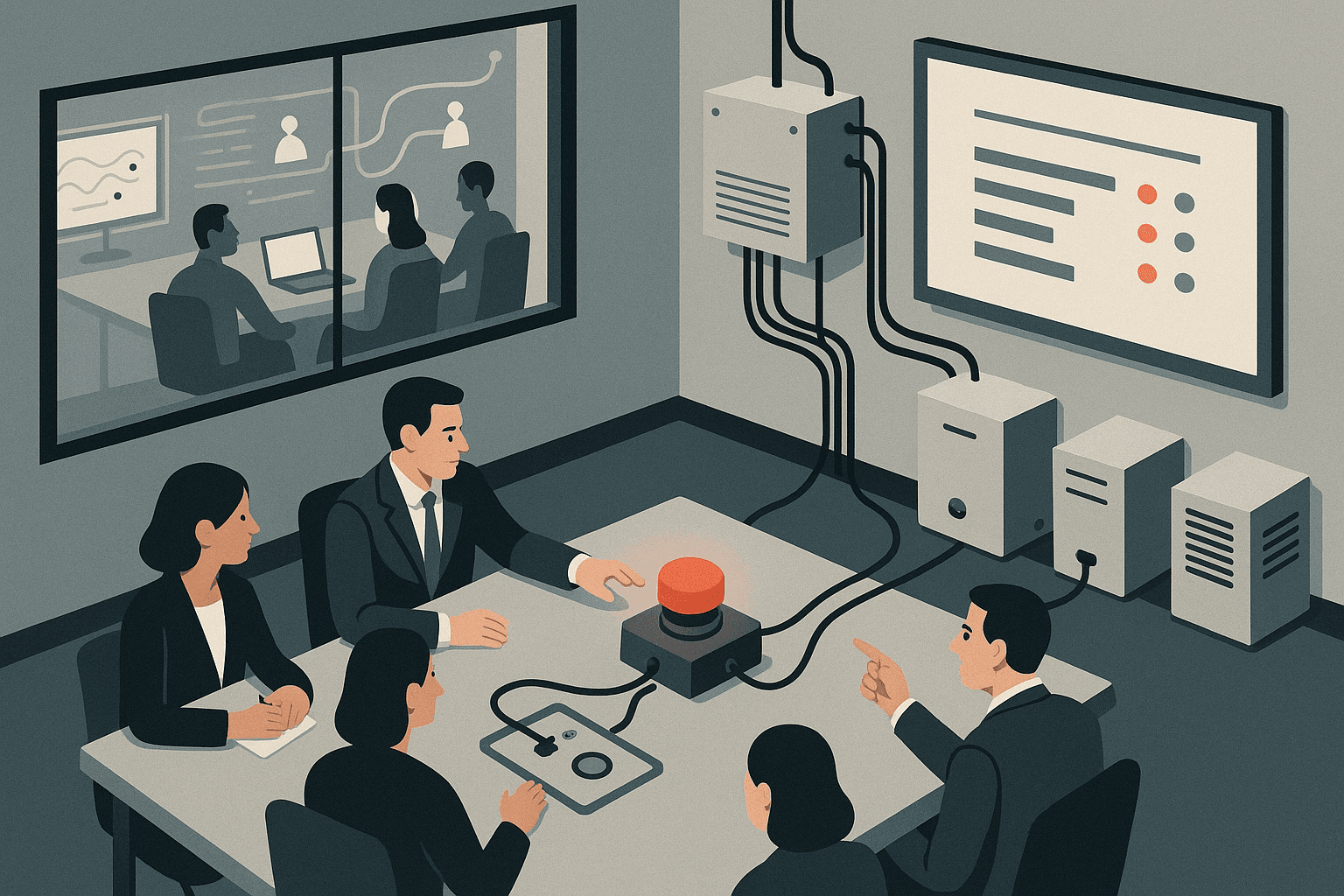
Monitoring, logging, and human review are table stakes. The differentiator is containment.
For each significant AI system, you should be able to answer "yes"—and demonstrate how—to questions like:
- Can we stop it? Is there a tested kill switch that can disable or isolate the system within minutes if it misbehaves?
- Is its purpose bound? Are there technical controls (not just policy language) preventing the system from being used outside its approved use cases?
- Can we prove what it did? Can we reconstruct, for a given decision or case, what the system saw, what instructions it followed, which tools it invoked, and where a human intervened?
A recent agent‑governance panel put the bar crisply: the real test is whether your organization can prove what an agent accessed and decided, not just whether you can say it was "under human supervision."
3. Vendor AI as a material-change trigger
Your vendor governance program needs to treat AI as a material change, not a feature tweak.
That means:
- Updating vendor due diligence to distinguish between vendors who develop AI components and vendors who merely use AI internally.
- Requiring vendors to disclose when they introduce AI or make significant changes to AI that affects your data, customers, or financial outcomes.
- Defining clear remedies and exit options if a vendor’s AI changes your risk in ways you can’t accept.
In practical terms, your third‑party risk team (even if it’s one person wearing several hats) needs to answer three questions at any point in time:
- Which vendors materially influence our outcomes using AI?
- How would we know if one of them introduces or changes AI in a critical workflow?
- What evidence would we rely on to defend our oversight if challenged tomorrow?
With nearly half of breaches now involving a third party, and professional‑services third‑party incidents up triple digits in recent reporting, this is no longer optional.
4. A simple AI board scorecard on one page
Leading governance programs are moving away from thick binders and toward a simple scorecard that fits on a single page.
An example set of board‑level metrics, adapted from bank regulators to a general service‑company context:
- Inventory completeness – % of business‑critical systems with AI usage documented and owned.
- Vendor AI disclosure coverage – % of key vendors who have disclosed whether and how they use AI in services that affect you.
- Override rates – where humans can override AI decisions, how often they do so. Both high and low override rates are investigation signals (high: AI not trusted; low: rubber‑stamping).
- AI incidents – number, severity, and time‑to‑containment for issues where AI contributed to an error, breach, or customer harm.
- Training completion by role – % of front‑line, manager, and executive staff who have completed role‑appropriate AI and governance training. Anything under ~90% in a critical function is a board‑level concern.
- Regulatory and customer findings – trend of exam findings, complaints, or customer audits touching AI.
The test of a good scorecard: directors should be able to skim it in five minutes and know where to ask questions. It is an operating tool, not a marketing artifact.
Why this matters for growth, not just risk
It is tempting to treat all of this as defensive work—important, but separate from margin and growth.
That would be a mistake.
Two things are happening at once in 2026:
- AI is becoming an operating layer, not a feature pile. Multiple operators—from logistics to insurance—describe the real payoff as collapsing silos, reusing the same AI foundation across workflows, and letting agents actually do work, not just answer questions.
- AI governance has moved from operational risk to board‑level fiduciary responsibility. Investors, regulators, and insurers are now asking their own versions of the three questions above. Some are tying coverage and capital to the answers.
For service companies, that means the foundations you put under AI now will determine both your upside and your downside:
- A clear inventory and containment layer lets you take bolder bets on automation in dispatch, claims, billing, or customer service—because you can prove and, if necessary, stop what the system is doing.
- Strong vendor AI oversight gives you confidence to build on top of external platforms without blindly inheriting their risk.
- A simple board scorecard keeps AI from being a one‑off project; it becomes part of how you run the business.
IBM’s latest CEO study found that CEOs who redesign how decisions, handoffs, and governance work together are more than twice as likely to meet their AI business objectives. The operating model—how work and oversight actually run—is the differentiator.
Where to start in a 30–500 person service company
If you are leading a mid‑market service business, you don’t need a 100‑page framework to get moving. You need a focused first pass that can be improved.
A practical starting sequence:
- Pick one critical workflow where AI is already in use or clearly coming—claims triage, dispatch, invoice review, customer support, underwriting, scheduling.
- Map every place AI touches that workflow: internal tools, vendor platforms, bots, scripts, "copilots." Name the owners.
- For each AI touchpoint, answer three questions:
- Is it in the inventory with a named owner and purpose?
- Can we stop or isolate it quickly if needed?
- If a regulator or customer asked us tomorrow to prove how it behaved in one specific case, could we?
- Fix the biggest gaps before you expand the use of AI in that workflow—especially missing containment and vendor visibility.
- Turn the answers into your first one‑page scorecard, even if it only covers that one workflow initially.
From there, you can extend to other workflows and vendors. The goal is not perfection on day one; it is to move from AI as a scattered set of experiments to AI as a governed operating layer you can explain and defend.
The board question that unlocks real progress
The most powerful thing a board or owner can do this year is not to commission another strategy deck. It is to make AI governance a standing agenda item and change the questions they ask.
Instead of "What AI are we using?" try:
- Can we list, in fifteen minutes, every significant AI system and vendor that can affect our customers, employees, or money?
- For each one, who owns it, how can we stop it, and how would we prove what it did if challenged tomorrow?
If the answers are confident and evidenced, you are ahead of most of the market. If they are vague, this is your window to fix it—before a regulator, insurer, or angry customer forces the issue on their terms.
Governance will happen either way. The only real choice is whether you design it to support the way you want your service business to operate—or inherit whatever has quietly grown under the surface.